
Macon Previous Resident Sources
No single record lists every person tied to a Macon address. Start with the current parcel card, then move through deeds, directories, census schedules, maps, and permit files. The strongest result labels each fact as ownership, occupancy, or a lead. That distinction matters because an owner's mailing address can differ from the property's physical, or situs, address. The era also controls where to search. Current parcel data is online, many twentieth-century directory volumes are digitized, and older deed books may require the clerk's public terminal or staff help.
| Record source | Known span | Custodian | Best evidence |
|---|---|---|---|
| qPublic parcel card | Current roll; sale depth varies | Bibb Tax Assessors | Situs, owner, mail address, parcel, structure, sales and permits |
| Bibb deed index | 1950 to current | Superior Court Clerk | Grantor, grantee, instrument, book and page |
| Macon directories | Digitized items, 1860 to 1964 | Washington Memorial Library and DLG | Named residents, work, spouse clues, and addresses |
| Federal census | Public through 1950 | NARA and library access | Named household at ten-year intervals |
| Maps and permits | Varies by series | Library, assessor, and Macon-Bibb | Building continuity, alterations, and address context |
For a recent transfer, use qPublic and the deed index first. For past residents between census years, search a directory street section and then its alphabetical entries. For an older structure, maps and the legal description help prove that the same lot is being followed. Historic Macon's handbook also points house researchers to city directories, Sanborn and ward maps, newspapers, and deeds.
Begin With Macon Parcel Records
The Bibb County Board of Tax Assessors links to the free qPublic search. Enter the location address and save the parcel number, legal shorthand, current owner, separate mailing address, homestead entry, structure facts, and any listed sales or permits. A parcel is the assessor's mapped unit of land. It is a better bridge to deeds than a street string alone.
A current card is a starting point, not a roster of previous residents. Homestead status may support owner occupancy, but it does not name everyone in the home and may lag a move. Sale rows are leads as well. The inspected Bibb card can label a transfer as a tax deed, foreclosure, bank sale, outlier, or unqualified transaction, so price alone should not be treated as ordinary market proof.
The parcel card can also help distinguish the land from the building. Bibb records may show class, tax district, acres, neighborhood code, land-lot and district references, plus improvement details such as year built, heated area, room counts, roof, and condition. Those fields can test whether a directory entry likely refers to the structure standing today. The card's legal description is expressly abbreviated and not suitable for legal documents, so copy the full description from the recorded deed before extending the chain. Preserve spaces and suffixes in an alphanumeric parcel ID. Even a small transcription error can point to the wrong tract.
Macon Deeds Run Backward
The Bibb clerk states that its online land index covers 1950 to the present. Guest users can inspect index information, while document viewing, printing, and downloading can require an account and service terms. The Bibb clerk login and guest gateway is the local starting point.
The screenshot below comes from that official gateway.
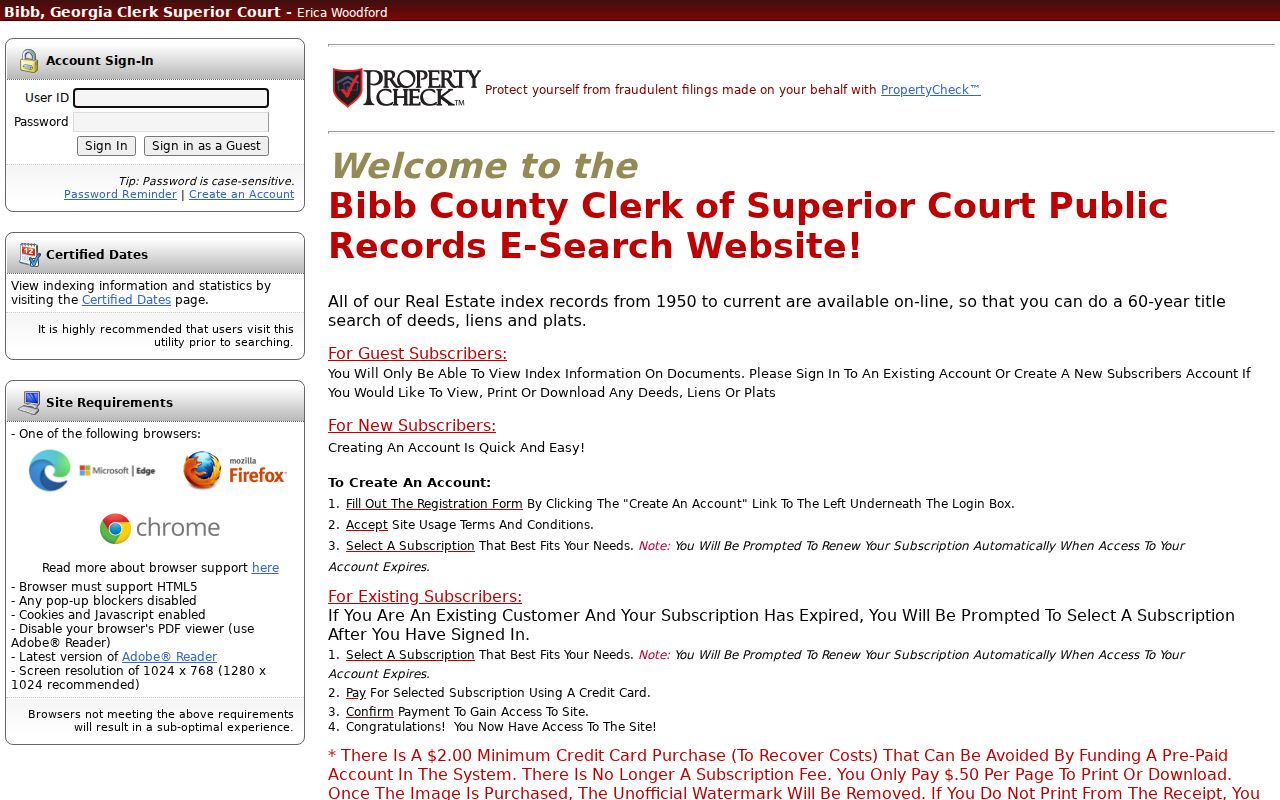
It confirms that the clerk remains the source for land and historical index work, even when a statewide system is also used.
Trace Bibb County Past Owners
A chain of title is the sequence of recorded transfers for the same land. Begin with today's owner and acquisition deed. Then alternate seller and buyer roles to move backward, keeping the legal description and book-page references stable. This method avoids the false idea that a modern street address is a durable deed key.
- Copy the present owner, parcel ID, legal shorthand, and latest deed book and page from qPublic.
- Find that acquisition deed. Record both parties, instrument type, dates, legal wording, and prior-deed reference.
- Search the seller as a grantee to locate that person's earlier acquisition. Try initials, spouses, estates, trustees, and business names.
- Repeat while the parcel or legal description still matches. Treat each kind of deed as a distinct record.
- Before 1950, take the last book-page and legal description to the clerk's public terminal and older books.
- Grantor and grantee
- The grantor transfers an interest; the grantee receives it.
- Chain of title
- The linked run of deeds for the same land.
- Legal description
- The recorded land description, often by lot, block, plat, or boundary, that survives address changes.
The GSCCCA Real Estate Index offers name, property, and book-page modes. Every county reaches at least January 1999 there.
The official statewide search appears below.
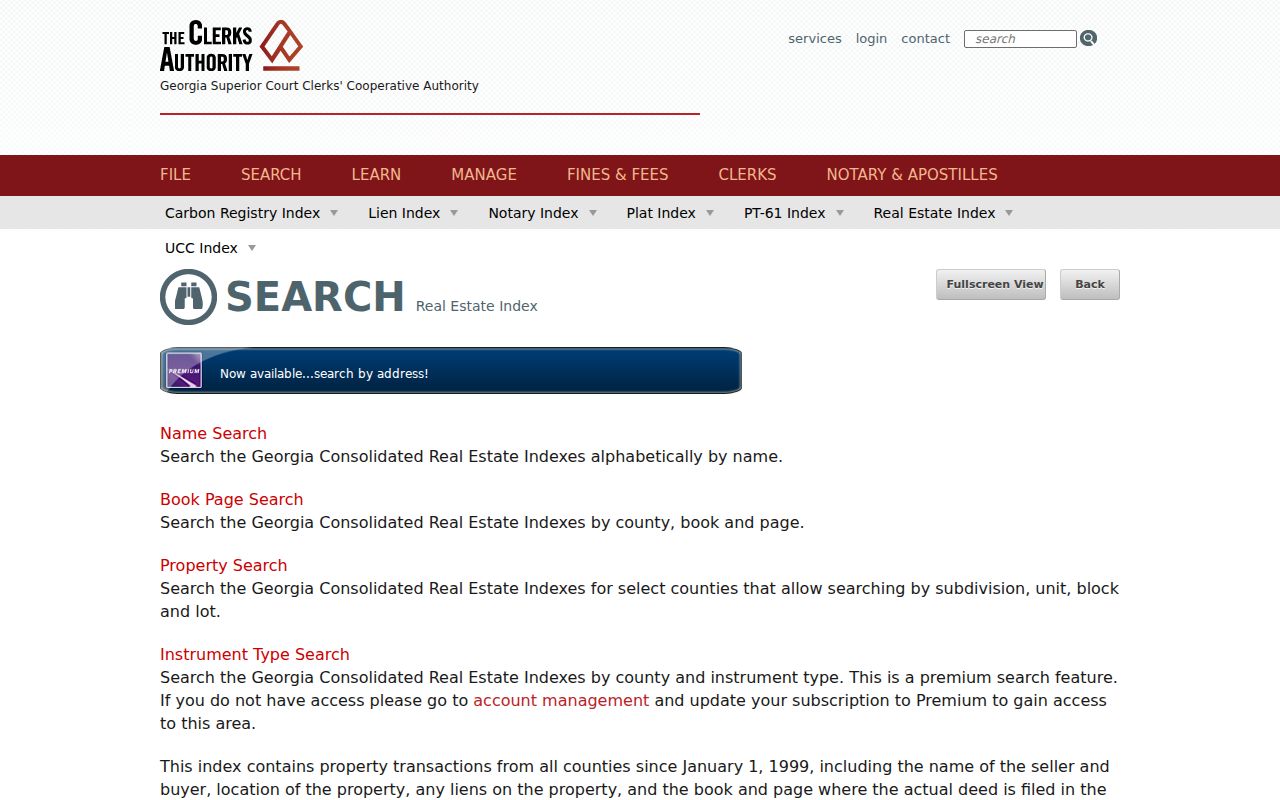
Use it as an alternate index, then seek certified land records from the Bibb clerk.
The GSCCCA real estate search guide explains those index methods.
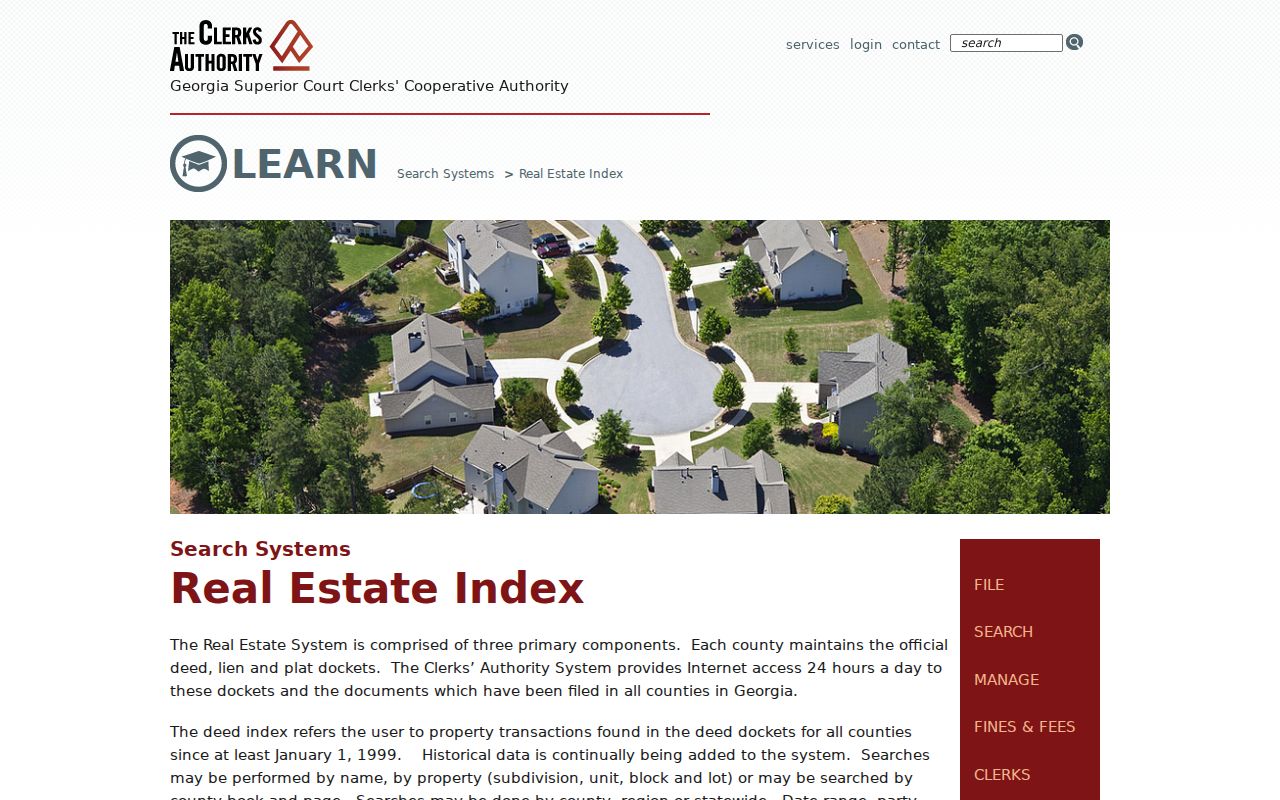
Its field guidance separates a name search from property and book-page searches.
Three Macon Directory Search Paths
The 1925 Polk volume works like three databases in one book: alphabetical names, a street and householder section, and a classified business section. For previous residents, begin in the street section, note each listed householder, then inspect the alphabetical entry for work, spouse, or boarding details. Search the business section when a shop or firm was tied to the address.
Optical character recognition can miss initials and old abbreviations. Browse page images when full-text search fails. The broader Macon city directories collection explains the volumes, while this address trail uses them to test occupancy.
Note: A directory survey could omit people who moved, refused, boarded, or fell outside that edition's stated coverage.
Macon Maps Test Address Continuity
Historic Macon's house-history method combines Sanborn and ward maps with directories, newspapers, and deeds. A map can show whether a structure existed, whether a lot was split, and how an old address sat within its block. It generally does not name an occupant. Preserve the legal description whenever street text is uncertain, since no full official Macon renumbering chronology was found.
Permit entries can date an addition, demolition, or rebuild. Some qPublic cards list a date, number, type, and description. When the card is thin, submit a focused request through Macon-Bibb Open Records with situs, parcel, record type, and date span.
Macon and Bibb County consolidated in 2014. For files that cross that date, search or request under both the former City of Macon and current Macon-Bibb names. Municipal environmental cases may concern buildings, unsafe-property work, nuisance abatement, sanitation, or property maintenance. They can associate an owner or defendant with a site, but do not prove that person lived there. A focused request should ask for the permit or case number, application, owner shown, applicant or contractor, issue and final dates, inspections, work description, and notices. Existing electronic copies can reduce cost. Georgia's Open Records Act generally calls for a response within three business days, though an office can identify more time, costs, or a statutory exemption.
Macon Previous Resident Fallbacks
Washington Memorial Library's Genealogical and Historical Room and Middle Georgia Archives hold maps, drawings, newspapers, yearbooks, church and organization records, and Macon directories. Staff can work best from a full name, variants, address, neighborhood, spouse, occupation, and narrow date range. Ask staff to verify current hours, copy policy, reverse-directory years, and newspaper holdings.
The FamilySearch Bibb County catalog adds another path, though access varies by item.
This catalog capture shows the source.
A restricted image is not the end. Use the description to identify the record group, then check the library, Georgia Archives, or Bibb custodian.
Older Macon research may also require a geographic step. Bibb County was created in 1822 from parts of Houston, Jones, Monroe, and Twiggs counties. An event involving the same land before county creation may sit in a parent-county, state, or federal series rather than a Bibb volume. Later directory titles also define their own reach. A 1945 volume names mill villages and neighborhoods such as Bellevue, Ingleside, Lynmore, Payne Mills, Shirley Hills, Unionville, and Western Heights. Search those historic community names along with the modern street. A missing name may reflect the edition's boundary, not an absent resident.
Recovered Macon Deed Books
In 2013, Clerk Erica Woodford found 18 deed books in a courthouse mezzanine, each reported at about 1,000 pages. The books include transactions that recorded enslaved people. A 2025 Enslaved People Project seeks to restore names and humanity to people treated as property in those records. This history must be handled as evidence of violence, not as ordinary house-history color.
The find also proves that online results do not define the full archive. Ask the clerk whether a needed book, image, or project index is available. No official source establishes a destructive Bibb courthouse fire or a precise land-image cutover.
Macon Past Household Evidence
Deeds identify owners, not all previous residents. Pair each ownership span with the closest directory years and the public federal census, now open through 1950. In the 1924 Polk street guide, an address can lead to a householder or vacancy. An alphabetical entry may add a spouse, occupation, employer, boarding status, or widow notation.
Use a simple flow: address in street guide, named entry in that volume, nearby census year, then obituary or probate lead. Record the title page and abbreviation key. First appearance can bracket arrival, but disappearance proves nothing. Obituaries may supply relatives and cemetery clues, while probate files can close the trail.
Lawful use. Research Macon previous residents for house history, genealogy, estate work, or personal curiosity. Never use a record trail to track, harass, or harm a living person.