
Inspect Macon’s 1860 Directory
The earliest verified scan in the digital result run shows why page images matter. Its entries may give work, business location, a house or boarding place, a relative street position, and a widow notation. The printed page preserves spacing and capitalization that uncorrected OCR can lose.
The Digital Library of Georgia 1860 Macon directory record is shown in the successful capture below.
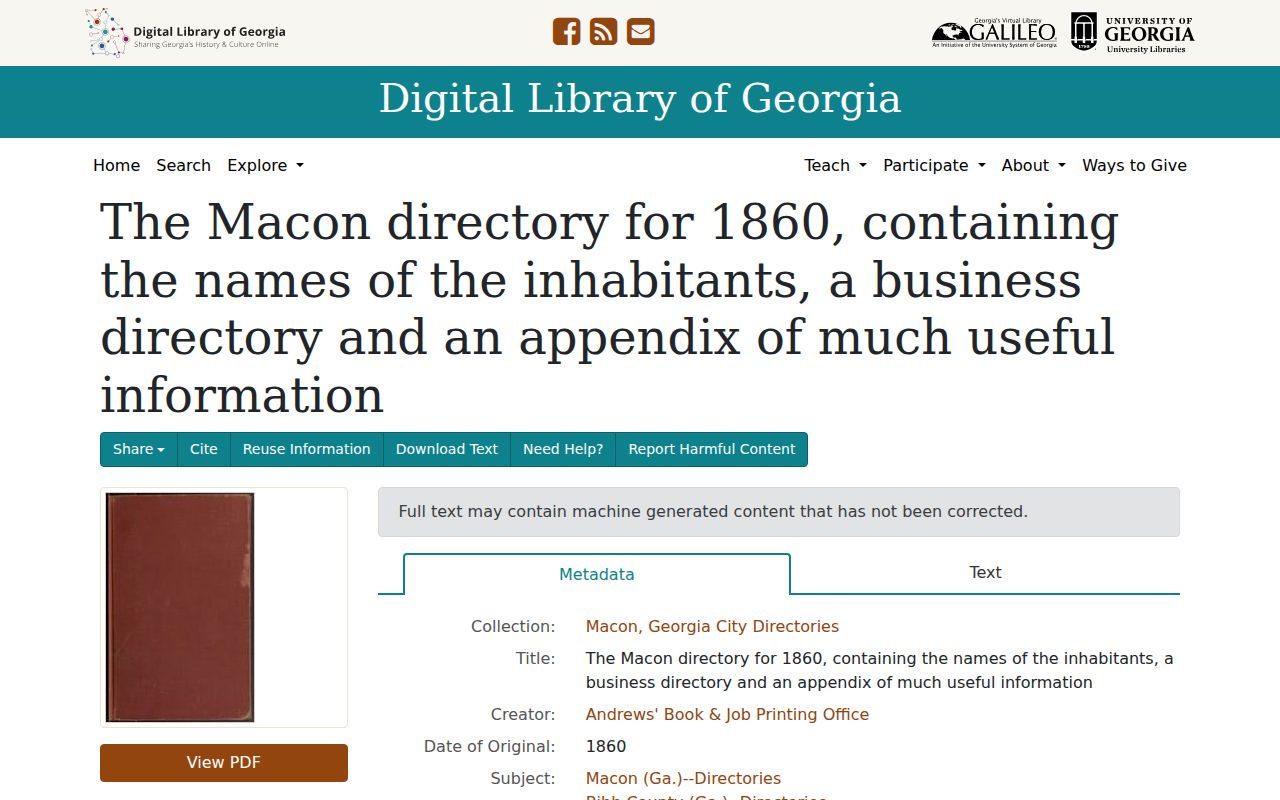
The item record anchors the edition and its source institution. Open the scan from that record, save the page number and image, and read the key before expanding an abbreviation. Relative locations such as “near,” “between,” or “opposite” may be more useful than a modern number when paired with a ward map.
Macon Directory Collections by Year
The main digital run comes from Washington Memorial Library and the Middle Georgia Archives. The Digital Library of Georgia catalogs 68 full-text items with results spanning 1860 through 1964. Individual edition metadata controls the precise year and publisher. Physical telephone, reverse-directory, and post-1964 coverage still requires a staff check.
| Collection | Years | Where held | Access |
|---|---|---|---|
| Digitized Macon city directories | Results 1860-1964 | Washington Memorial Library via DLG | Free full-text records and page images |
| Selected 1930s directories | 1930, 1932, 1934-1935 | National Archives inventory | Check NARA access and copy route |
| Physical and reverse volumes | Exact shelf years unverified | Genealogical and Historical Room | Ask staff before visiting |
| Companion local collections | Varies by collection | Middle Georgia Archives | Digital items plus staff-assisted originals |
There is no support for a guessed “last printed year” or a claim that every year survives. A gap in the gallery may mean an edition was not issued, was not preserved, or has not been digitized. Ask about the physical shelf, newspaper microfilm, yearbooks, and licensed databases before ending the search.
Search Macon Directories in DLG
The Digital Library of Georgia Macon directory collection supports searching Records and Full Text together, metadata only, or full text only. Facets include creator, subject, location, county, year, medium, rights, collection, and institution. Quoted phrases, plus and minus signs, uppercase Boolean terms, and parentheses are supported. Wildcards and truncation are not.
OCR, the machine-made text behind page search, is explicitly uncorrected. Try a surname alone, initials, a spouse, occupation, employer, and street. Then browse the alphabetical page images. A missed hit may reflect type, a torn page, an abbreviation, or the scan rather than an absent resident.
The collection page itself failed during image capture, so no failed screenshot is used. The source link still reaches the correct collection when DLG service is available.
Decode a Macon Directory Entry
The inspected 1860 edition often gives a surname and given name or honorific, occupation, workplace, business address, and residence or boarding location. It may name a deceased spouse after “wid.” Many entries use relative places such as a street near or between two others rather than a house number. Capitalized names can denote advertisers or subscribers in that edition.
| Name | Surname, given name, initials, or honorific |
|---|---|
| Work | Occupation, employer or business, and sometimes its address |
| Home | House, boarding place, street number, or relative street location |
| Family clue | Spouse or widow notation, sometimes with the deceased spouse’s name |
| Edition clue | Typography or symbol whose meaning must be checked in that volume |
In 1935, the title promises full name, spouse, number of children under 16, ownership designation, position or employer, and an address for people over 16. That rich list is still not a census. Surveyors could miss, exclude, or be refused by residents.
- Criss-cross directory
- A street-and-number section that changes an address into a householder lead.
- Householder index
- A street-order list of the person associated with each numbered place, sometimes including vacancies.
- Abbreviation key
- The edition’s own glossary for marks such as “bds.” for boards, “h.” for house, and “wid.” for widow.
Visit Macon’s Historical Directory Room
Washington Memorial Library’s Genealogical and Historical Room and Middle Georgia Archives are at 1180 Washington Avenue. Email mgrlgh@bibblib.org. The Middle Georgia Archives institution record describes correspondence, diaries, scrapbooks, maps, architectural drawings, and club, church, organization, and business records. Those sources can explain a name or address that a bound directory leaves vague.
The archive holdings view appears below from its official DLG institution page.
The catalog view confirms the local institution behind many scans. Ask staff for exact physical directory and telephone-book years, reverse directories, obituary indexes, newspaper microfilm, yearbooks, current hours, copy fees, and access to any licensed databases. Give a full name and variants, years, street or neighborhood, spouse, and occupation. A bounded request is much easier to answer.
Macon City Directory Publishing Milestones
Publisher names and page layouts shift across the Macon city directory run. A short timeline helps keep a copied entry attached to the right format.
| Year | Directory milestone | Research value |
|---|---|---|
| 1860 | Earliest verified digital item in the DLG result run | Occupations, work sites, homes, boarding places, and widow notes |
| 1884 | Interstate Directory Co. and H. H. Dickson edition | Shows a publisher change within the nineteenth-century run |
| 1887 | Washington Poe and J. W. Burke & Co., 270 pages | Edition-specific imprint anchors citations |
| 1922 | Verified R. L. Polk edition | Part of the later publisher era |
| 1924-1925 | Street and householder sections documented | Supports reverse address work |
| 1945 | Edition names mill villages and developments | Broadens search terms beyond central Macon |
| 1964 | Latest year in the verified DLG result range | Not proof that local print publishing stopped |
Bibb County itself began in 1822 and Macon incorporated in 1823. Events before county creation may require parent-county, state, federal, or archival series rather than a city directory that did not yet exist.
Reverse a Macon Directory Address
The 1924 Polk “Street Guide and Directory of Householders” arranges a street, its direction or range, then a number and householder. It can mark a place “Vacant.” Academy Street, for example, is described from 614 Ocmulgee west to Walnut. Asterisks occur beside many names, but their meaning must come from that volume’s legend, not a guess.
Polk’s 1925 volume is three searchable works in one: alphabetical residents on pages 89 through 1002, street and householders on 1003 through 1134, and classified businesses on 1135 through 1232. Search the street section first, then use the name section to add work and family detail. For present parcel ownership, switch to the Macon street directory records instead of projecting an old householder into today.
Note: A vacancy mark proves only what that edition’s survey reported, not the condition of the parcel before or after publication.
Trace Families Through Macon Directories
One edition is a snapshot. A sequence can bracket an arrival, a move, a change in work, marriage, or a possible death lead. It must still be checked against independent records.
- Search the full name in quotes, then test initials, spelling variants, a spouse, and occupation. Browse the images when OCR fails.
- Copy the exact entry, edition, title page, abbreviation key, spouse or widow note, work, boarding or house status, and address.
- Check the same volume’s street guide for the address, adjacent numbers, and vacancy marks.
- Move through available editions. Record the first and last appearance, but do not treat disappearance alone as death or departure.
- Pair the sequence with released federal census schedules. The 1950 census is the latest public schedule in 2026 under the 72-year rule.
- Use probate, deeds, obituaries, newspapers, Sanborn or ward maps, and yearbooks to test the resulting theory.
Census schedules name a household at a decennial point. Directories can fill years between them, but each has its own survey limits. A widow notation is a death lead, not a certificate. A changed address can be a move, renumbering, or a new wording for the same place.
Search Macon Directory Neighborhood Names
The 1945 edition explicitly covers Adams Mill, Bellevue, Brookwood, Crumps Park, Hillcrest Heights, Ingleside, Lynmore, Log Cabin Heights, Macon Textile Mills, Mikado Place, Payne Mills, Shirley Hills, Unionville, and Western Heights. Those labels matter because the directory’s geography does not match only the current consolidated government or modern postal city.
Search both a street or subdivision and the old mill or community name. Macon and Bibb County consolidated in 2014, so historic City of Macon counts and modern Macon-Bibb figures describe different areas. Each volume’s title and coverage statement should be captured before deciding that a family was outside the directory.
Bridge Gaps in Macon Directories
Newspapers can place a person between editions through notices, obituaries, advertisements, and civic news. The Historic Macon house-history handbook directs researchers among directories, Sanborn and ward maps, newspapers, and deeds. School yearbooks can restore a classmate or family member whom an adult-focused directory omitted. Church and club archives may help too, though donor limits can close living-person details.
Middle Georgia Archives also lists the Isaac Scott diary from 1859 to 1864, Macon-Knoxville store ledger from 1825 to 1831, Georgia State Fair records from 1886 to 1960, school yearbooks, Douglass Theatre records, and business or church archives. FamilySearch’s Bibb catalog and Georgia Archives provide further record groups, subject to account, image, or on-site rules. No official unified Bibb obituary index was found, so family-submitted notices need corroboration.
Macon Archives Continue to Grow
Historic Macon is digitizing photographs, video, and papers inherited from predecessor groups through Washington Memorial Library’s Memory Lab. The work includes material tied to Huguenin Heights, Pleasant Hill, and Third Street, but no completion date is stated.
The Historic Macon archives project is shown below from its successful capture.
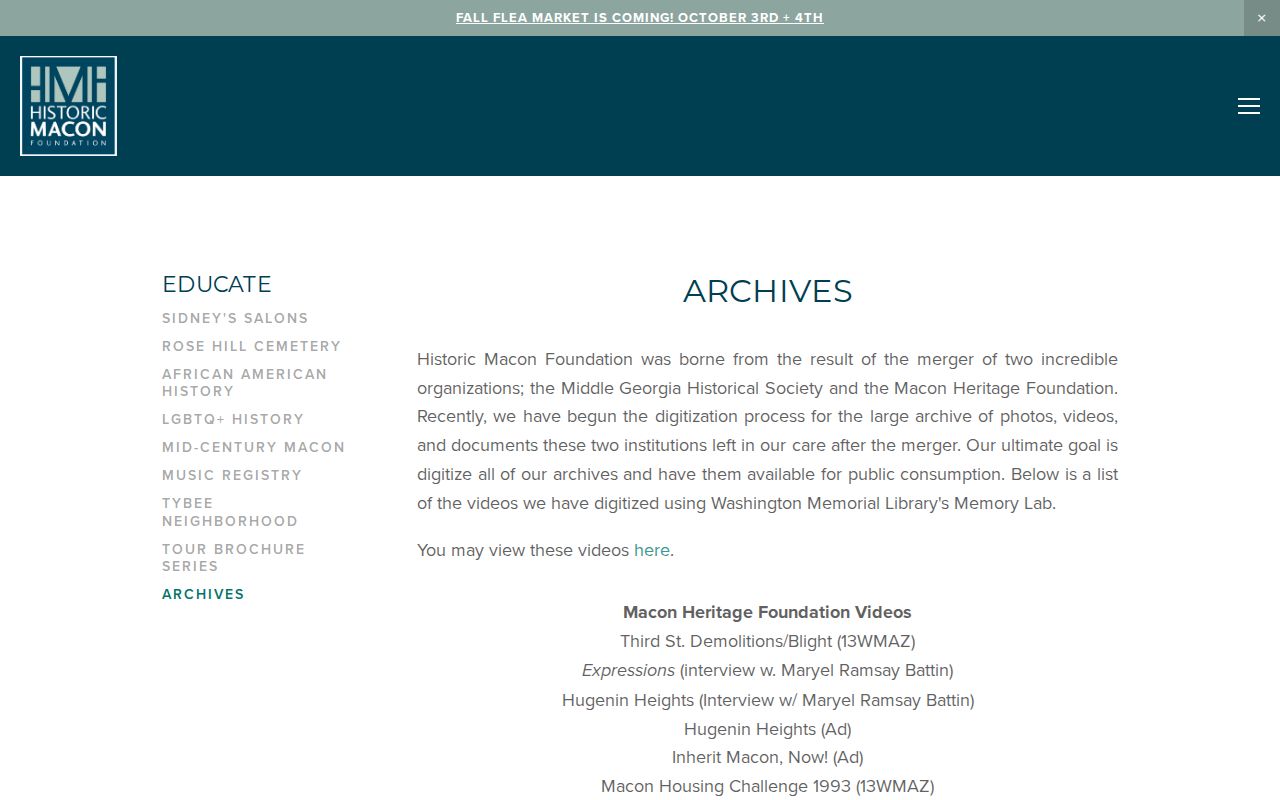
This growing archive can supply visual and neighborhood context around a directory address. It does not replace the edition citation or prove that a pictured person occupied a site.
A separate local story sits in the courthouse record chain: 18 deed books of roughly 1,000 pages each were rediscovered in a mezzanine, including transactions that recorded enslaved people. Those records must be handled as evidence of historical violence, not as routine property listings. Availability of a public name index remains unverified.
Know Macon Directory Search Limits
A city directory survey can miss people who moved, refused, boarded briefly, lived outside its stated area, or were not within the publisher’s scope. OCR can miss a clear printed name. Street numbers and neighborhood terms can change. Exact physical years after 1964, reverse-directory coverage, map runs, obituary indexes, newspaper holdings, and copy fees require staff confirmation.
Cite the edition, page image, title, publisher, and access date. Keep uncertainty where it belongs. A directory entry is excellent evidence that a publisher associated a named person with an occupation or place in that edition, but it is not proof of every member of a household.