
Begin a Macon Resident Search
A useful Macon search begins with the kind of fact you want to confirm. An address belongs first in the assessor records. A land transfer belongs in the deed index. A civil or criminal case belongs in the court portal, while an older household belongs in a printed city directory. Starting in the right place avoids a common mistake: treating every name match as the same person. Record the middle name, parcel number, case number, date, and role whenever those details appear.
Official records describe events, filings, and legal relationships. They do not create a complete household list. A tax owner may live elsewhere, a renter may not appear on the parcel card, and a voter tool may be limited to the voter checking their own registration. Compare two independent sources before drawing a conclusion.
- Search the Bibb assessor by owner name or location address, then keep the parcel number.
- Use Georgia My Voter Page only for an authenticated self-lookup.
- Check Bibb eSearch for deeds, liens, plats, and historical land filings.
- Use re:SearchGA when a name may appear in a participating civil or criminal court file.
- Ask Washington Memorial Library or the correct custodian when the needed year is not online.
Where Macon Resident Records Live
Macon and Bibb County consolidated in 2014, so most resident records are county-centered even though each custodian still has a narrow job. The Superior Court Clerk keeps land, historical, civil, and criminal court material. The Board of Tax Assessors maintains parcel cards and values. The Board of Elections handles local registration questions, precinct records, and corrections. Knowing that split matters because the tax office that collects a bill is not the assessor that values the parcel, and neither one certifies a deed.
Bibb Superior Court Clerk
601 Mulberry Street, Suite 216
Macon, GA 31201
478-621-6527
Macon-Bibb Tax Assessors
688 Walnut Street, Suite 200
Macon, GA 31201
478-200-5550
Search Macon Parcels by Address
The Macon-Bibb assessor roll is the strongest first stop when an address is known. Its free qPublic search accepts an owner name, parcel number, location address, or legal description. A parcel card can show separate situs and owner-mailing addresses, recent sales, deed book and page references, land and building facts, exemptions, and some permits. The situs address identifies the property location. The mailing address is where tax notices go, so it cannot prove that an owner lives on the parcel.
| Search control | Use | Important limit |
|---|---|---|
| Owner Name | Find parcels by a person or organization | Name order and wildcard rules are not published |
| Parcel Number | Return to one stable tax record | Keep all letters, digits, and spacing |
| Location Address | Match a street number and name | Test direction and street-name variants |
| Legal Description | Find abbreviated land text | Not a substitute for the recorded deed |
| View Map | Open mapped parcel context | Map lines are not a survey |
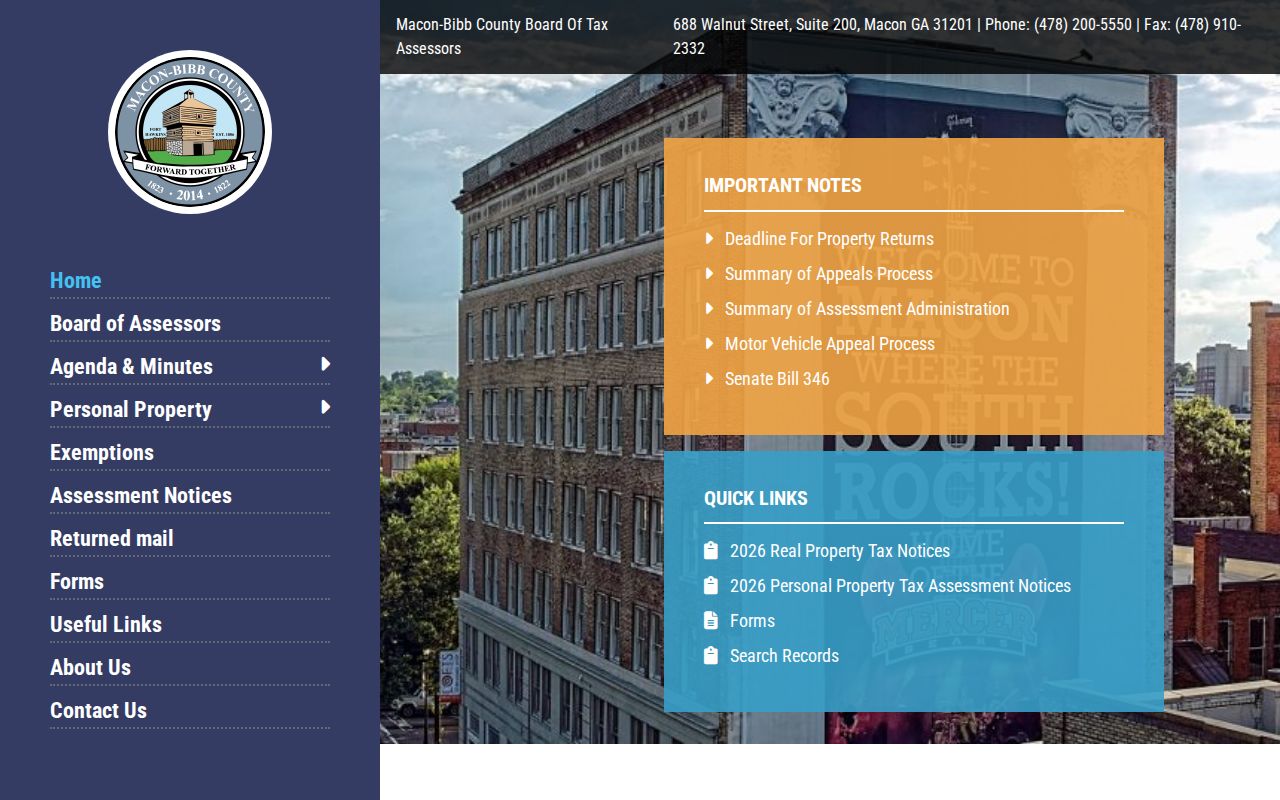
The Board of Tax Assessors gateway leads to the public record search. Its home screen is shown below.
Macon Court Portals Split the Work
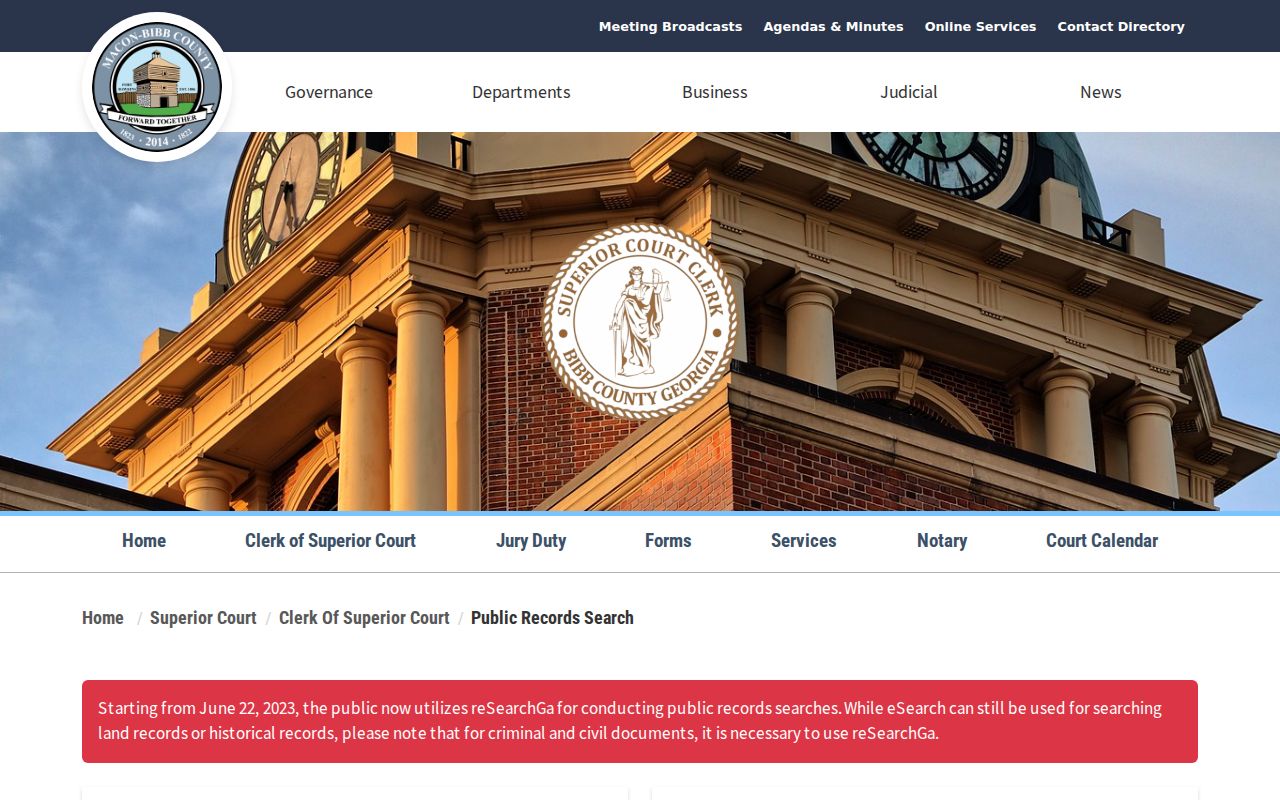
Bibb County does not use one portal for every court and land record. Since June 22, 2023, participating civil and criminal document searches run through re:SearchGA. Bibb eSearch remains the route for land and historical records. The Georgia Judicial Gateway can help locate statewide court access, but the local clerk remains the source for certified copies and questions about a Bibb file. Court indexes may show party names, case numbers, filing dates, case types, and docket events. A docket is the chronological list of filings and actions in a case, not the complete document set.
| System | Best use | Access caution |
|---|---|---|
| Bibb eSearch | Deeds, liens, plats, and historical land material | First complete online year is not published |
| re:SearchGA | Participating civil and criminal court records | Account or payment may govern document access |
| Clerk counter | Older books, local help, and certified copies | Bring the case or book-page reference when possible |
The Superior Court Clerk search gateway explains which system handles each record family.
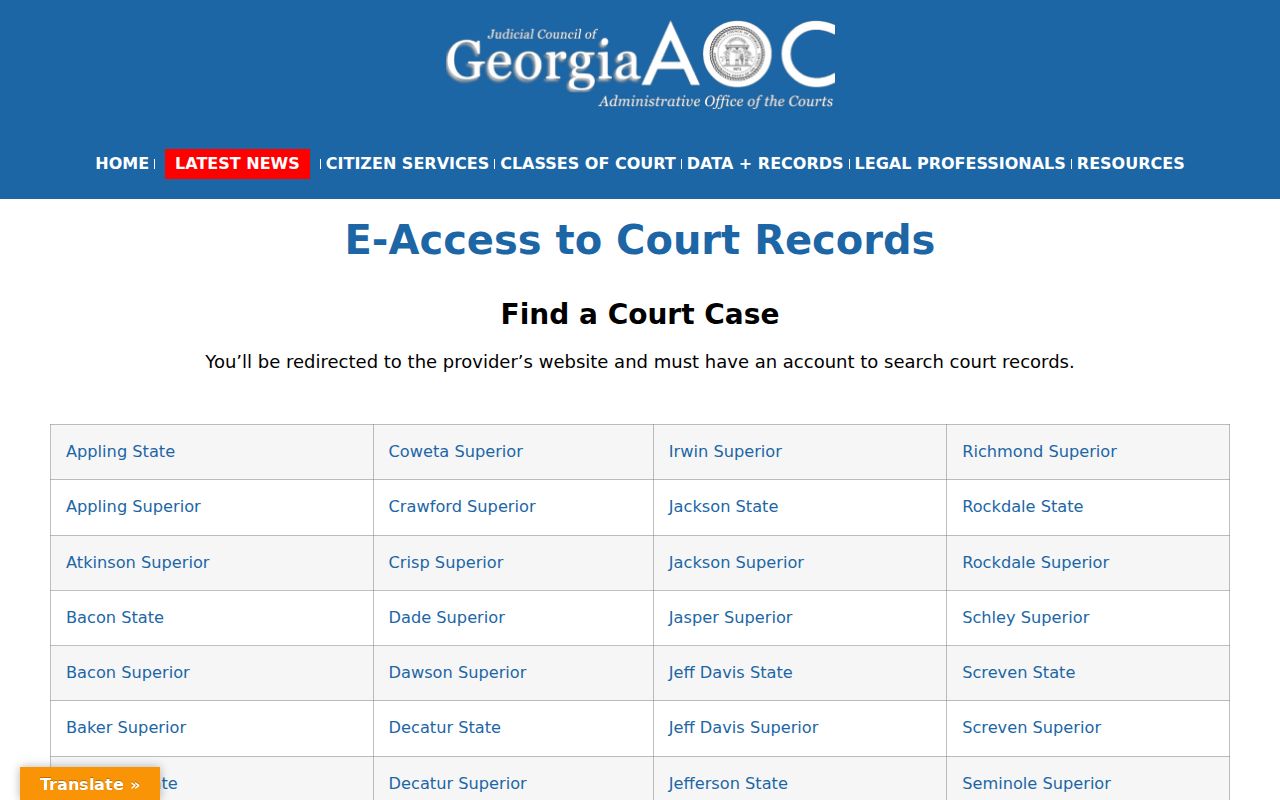
The Georgia courts eAccess directory provides the statewide path when a case may sit outside Bibb County.
Current Sources for Macon Residents
Modern public files act like partial resident directories because each lists a defined group. Their limits are as important as their names. The assessor lists owners, not all occupants. My Voter Page confirms the authenticated voter's own registration. The deed index identifies parties to recorded instruments. Court and custody systems list people only in their own legal scope. A name in one of these sources should be described by the record role shown, not treated as proof of a current home address.
| Official source | People included | Record keeper | Public route |
|---|---|---|---|
| Parcel and assessment roll | Current recorded owners | Macon-Bibb Tax Assessors | Free qPublic search |
| My Voter Page | The voter who authenticates | Georgia Secretary of State | Free self-lookup |
| Land and historical index | Parties to recorded instruments | Bibb Superior Court Clerk | eSearch and clerk counter |
| Civil and criminal case index | Named case parties | Bibb courts | re:SearchGA and clerk |
| Current custody roster | People held at Bibb LEC | Bibb County Sheriff | Free inmate search |
Commercial people-finder pages may blend old addresses and purchased data without showing the source. Official indexes are narrower, but they name the custodian and record type. That makes it possible to check the underlying filing and correct a mistaken match.
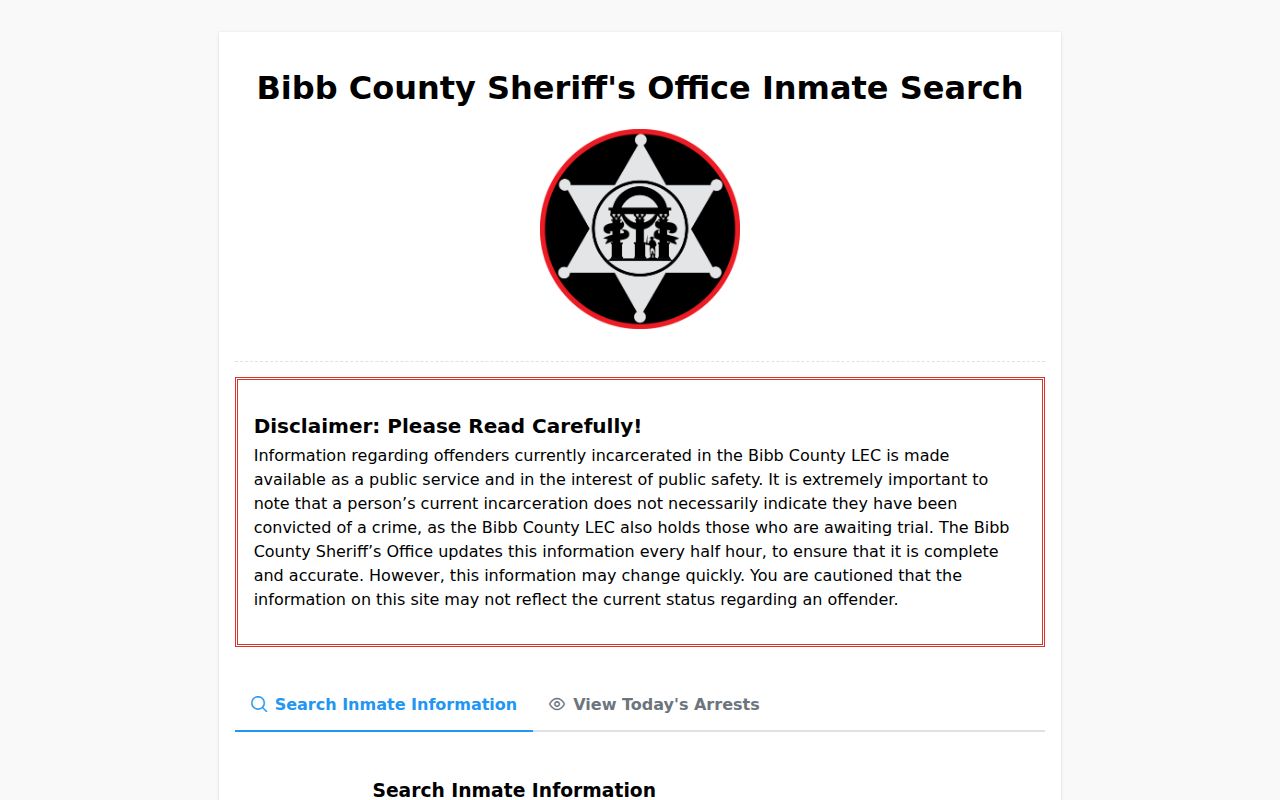
The Bibb County Sheriff's inmate search is limited to current local custody and warns that its information changes often.
Request Macon Records Not Online
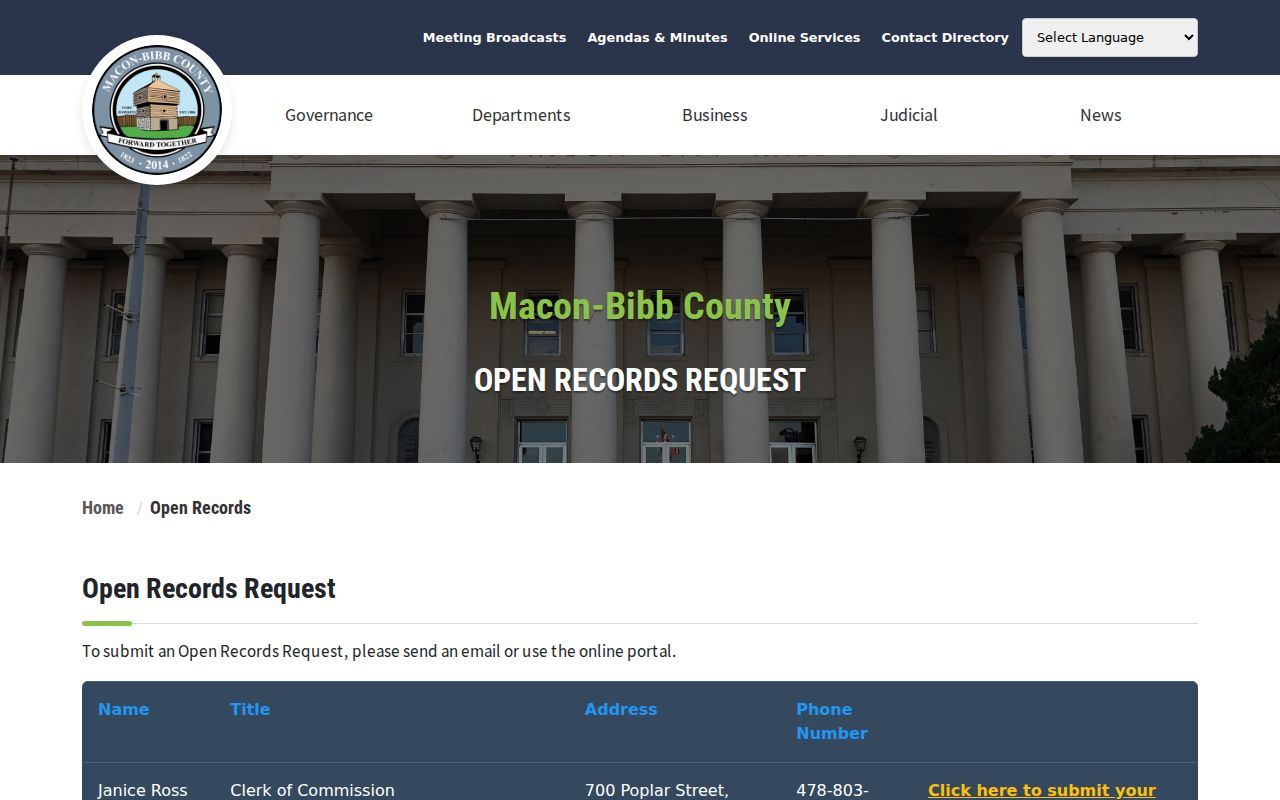
Georgia's Open Records Act, O.C.G.A. §§ 50-18-70 through 50-18-77, requires an agency response within three business days, subject to exemptions and reasonable search, redaction, and copy charges. A response is not always the record itself. An office may acknowledge the request, state when records will be ready, identify an exemption, or estimate lawful costs. Courts are different: Bibb State Court explains that the judicial branch is not an agency under the Act, although court records are generally open under court rules unless sealed or confidential.
Send a narrow request to the office that created or keeps the record. Include the record type, date range, address, parcel number, case number, and preferred electronic format. Ask for an existing file rather than an analysis the office would have to create. For parcel exports, address changes, permits, or historic tax maps, the county's central portal can route the request. Court copies should go to the clerk.
The Macon-Bibb open-records portal lists request channels and custodian routing.
Verify Macon Names Twice
Namesakes are common, and a search result can join facts that belong to different people. Keep each finding attached to its source and role. A deed may name a grantor, the person conveying land, or a grantee, the person receiving it. A court result may name a plaintiff, defendant, or attorney. A business filing may show a registered agent whose address is a professional service, not a home. Stable identifiers such as a parcel number, case number, license number, book and page, or full middle name are safer than a shared first and last name.
- Roll
- An official list created for a defined purpose, such as assessment or registration.
- Index
- A finding aid that points to a record; it is not always the record image.
- Parcel
- A mapped unit of land with a tax identification number.
- Criss-cross directory
- A directory arranged by street and house number instead of only by surname.
Use dates and roles to test a possible match. If a second source conflicts, preserve the conflict instead of forcing a conclusion.
Macon Voter Records Have Limits
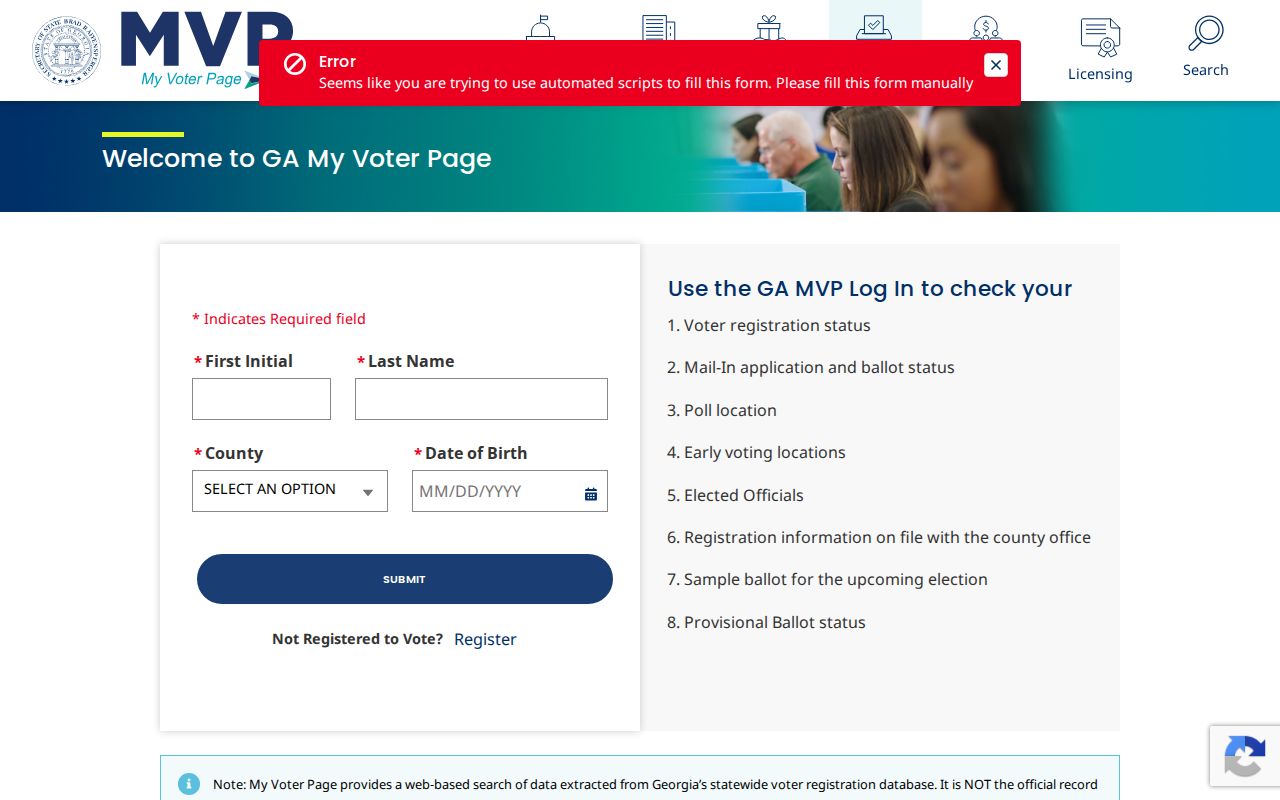
Georgia My Voter Page asks for first initial, last name, county, and date of birth. It returns registration status and information, polling place, districts, elected officials, sample ballot, and absentee or provisional-ballot status for the person who authenticates. It is not an open reverse-address roll. Formal voter-list orders follow a separate Secretary of State process, arrive electronically after payment, and exclude phone numbers, dates of birth, Social Security numbers, driver's-license numbers, and ballot choices.
VoteSafe can protect the registration address of an eligible survivor of domestic violence or stalking. That protection does not erase every deed, tax record, or old directory in which an address may appear. Georgia's Safe at Home provisions and the Georgia privacy act took effect July 1, 2026, but current coverage and operating details should be checked with the responsible state office.
Use records lawfully. Public access does not permit stalking, harassment, threats, or the creation of a sensitive household dossier.
The Georgia My Voter Page is the official self-service registration tool.
Macon Vital Records Follow Four Paths
Birth, death, marriage, and divorce records do not share one Macon custodian. Bibb County Health Department Vital Records and the Georgia Department of Public Health handle certified birth and death requests. Statewide birth and death certificates reach back to January 1919. Georgia DPH marriage holdings cover 1952 through 1996, while Bibb Probate Court handles local marriage licenses outside that state run. Superior Court keeps divorce files.
Georgia vital records are confidential under O.C.G.A. § 31-10-25 except for authorized disclosures. County death records, marriage applications and certificates, and divorce, dissolution, or annulment records remain publicly accessible under subsection (f). A search index is not a certified certificate. The official copy process can require identity, eligibility, payment, and a defined relationship to the person named. Start with the event type and date, then use the matching custodian.
Browse Historical Macon Resident Directories
Washington Memorial Library's Genealogical and Historical Room and Middle Georgia Archives form Macon's strongest historical people index. Their holdings include city directories, newspapers, Sanborn and ward maps, school yearbooks, manuscripts, photographs, church and club records, and microfilm. The Digital Library of Georgia catalogs Macon directories broadly from 1850 through 1950, with individual scans extending into the 1950s. NARA lists Macon volumes for 1930, 1932, and 1934 through 1935.
A directory entry may show a name, spouse, occupation, employer, business address, and home address. Street sections reverse the search, allowing a house number to lead to the listed occupant. The 1925 Polk volume contains alphabetical names, a street and householder section, and classified business listings in one binding. OCR may miss initials and abbreviations, so browse the printed page when keyword search fails. The full collections and reading method are developed in the Macon city directory.
Consolidation Changed Macon Geography
The former City of Macon and Bibb County became one consolidated government on January 1, 2014. That change makes old and current place labels easy to misread. A pre-consolidation city population is not the same geography as today's Macon-Bibb figure. Postal city names, ZIP codes, election districts, parcel boundaries, and historical corporate limits also answer different questions. One street can pass through more than one postal area, while a familiar neighborhood name may have no legal boundary.
Use the record's own geography. USPS confirms the deliverable ZIP for a full address. The assessor and GIS establish the parcel and tax district. Election records use precincts and districts. A historical directory defines its own coverage in the title and front matter. The 1945 directory, for example, named mill villages and developments such as Ingleside, Pleasant Hill, Shirley Hills, Unionville, and Western Heights. A failed search under “Macon” should therefore be repeated with the community or subdivision name used in that year.
Rediscovered Bibb Deeds Add Names
In 2013, Bibb Clerk Erica Woodford found 18 deed books in a courthouse mezzanine, each reported at about 1,000 pages. The volumes include transactions that recorded enslaved people. A 2025 Enslaved People Project began bringing attention and identity back to people whose names had been buried in property-era records. These books are not ordinary real-estate leads. They document a system of violence and should be described with that context.
The find also corrects the myth that every useful Macon name is already in a web search box. Ask the clerk or archives about book identifiers, indexing progress, and image access. Search related probate, estate, church, newspaper, and archival collections where a deed entry supplies only a partial name. The discovery is one example of why an online “no result” is not proof that no record exists.
Macon Resident Searches Need Fallbacks
Online access can fail even when the underlying Macon record is safe. During unusual county server activity in May 2024, the network was taken offline and court payments, tax and tag services, email, and phones were disrupted. Reviewed official material did not establish that resident data was taken, so the event should not be described as a confirmed personal-data breach. It does show why a portal outage and a missing record are different facts. Save the custodian's phone number, record identifier, and alternate access channel before depending on one web screen.
For land records, move from the assessor card to Bibb eSearch, the statewide GSCCCA real-estate index, and then the clerk's books or public terminal. For family history, move from a Digital Library scan to Washington Memorial's originals, newspaper microfilm, Historic Macon's ongoing archive work, Georgia Archives, or the FamilySearch catalog. Federal cases belong in PACER and the Middle District of Georgia clerk system rather than the local court portal. Each fallback preserves the scope of the question instead of turning a failed search into a claim about the person.
Write down what was searched and when. Portal names, access terms, and digitized coverage can change, while the book, case, parcel, or certificate remains under the custodian's control. A clear search log also makes a later phone call or written request much easier to answer.